What your company knows how to do isn't written down anywhere.
We write down every task in your company: who does it, how long it takes and how it's done, confirmed by your team. You get the company map and the procedures manual, ready for AI.
For companies of up to 100 people: the whole company in 2 weeks or less.
An example of what we deliver: the 72 tasks of a fictional haulage company with 100 people.
Each block is a documented task: who does it, when, how long it takes and how it's done. The driving itself isn't on the map.
Your company works. But how it works, only your people know.
Processes and procedures live in the heads of the people who do them, in emails and in files nobody updates. While those people are around, everything runs. When they're off, leave or change roles, the knowledge goes with them.
When someone leaves
of workers in the EU are 55 or older (17.9% ten years ago). When they retire, what they know how to do leaves with them, unless it's written down.
Eurostat, Labour Force Survey, 2025 (our calculation)
When someone new joins
of workers in the EU have been in their job for less than a year. Every new person learns by asking whoever knows, and whoever knows stops their own work to teach.
Eurostat, job tenure, 2025
When you want to use AI
of EU companies that considered AI but don't use it point to missing or poor-quality data. Without the company's knowledge in writing, AI has nothing to start from.
Eurostat, artificial intelligence in enterprises with 10 or more people, 2025
How much of this happens in your company? Take the self-assessment.
AI is only as good as what it knows about your company.
An AI assistant doesn't know your procedures. Without them in writing, it answers in generalities or makes things up. With them documented and confirmed, it answers the way your company works and says where the answer came from.
Generally, you should notify your insurer of the claim within the period set out in the policy and gather the accident report form, photographs and witness details. Then follow the loss assessment and the repair. The exact steps depend on your insurer and on the company's internal rules.
The Fleet Manager handles it, with the claim filed with the insurer within 24 hours:
- Collect the photos, the accident report form and the driver's account.
- File the claim with the insurer.
- Decide on the repair and the replacement vehicle.
- Tell the traffic office and accounts the outcome.
If the claim is filed after 24 hours, it has to be explained to the insurer.
Example using the demo company's procedure.
Decide with the whole company in view.
With every task in writing, with who does it, when and how long it takes, management questions get answers: where the time goes, where to start automating, where data is moved by hand. Three readings of the map above:
of the hours (4,546 h a year, the work of 2.7 full-time people) are in tasks with a high automation potential.
a year in just five tasks with a high automation potential: the place to start.
a year in 8 tasks that move data from one system to another by hand.
And when someone leaves, the procedure stays.
How we take the X-ray.
The X-ray covers the whole company and is ready in 2 weeks or less, for companies of up to 100 people. Above that, scope and timing are agreed in the call.
Gathering
Short conversations with the people who do the work, plus the documents that already exist: manuals, files, exports from your systems.
Structuring
Every task is written down: who does it, when, how long it takes and how it's done, step by step, with the system used. Every fact keeps its source.
Confirmation
Your team confirms what's written before it counts. When something changes, it's updated, and the base stays alive.
Then, on the same base
Tasks, people and times, confirmed by your team.
They read from this base, with the source of every fact.
When it makes sense, built on the same base.
What stays in your company.
A glimpse of what we deliver, with the demo company's real documents (in Portuguese).
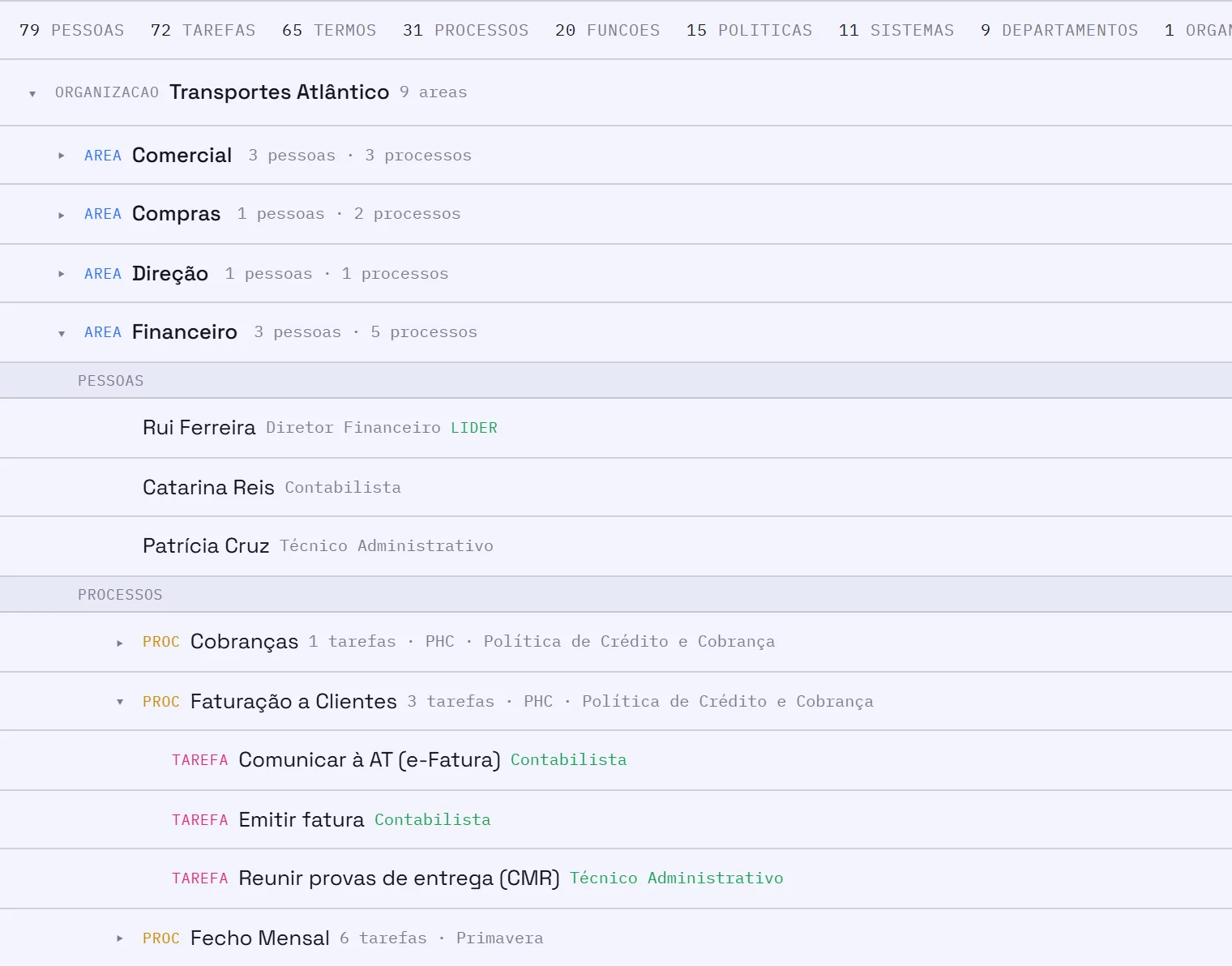
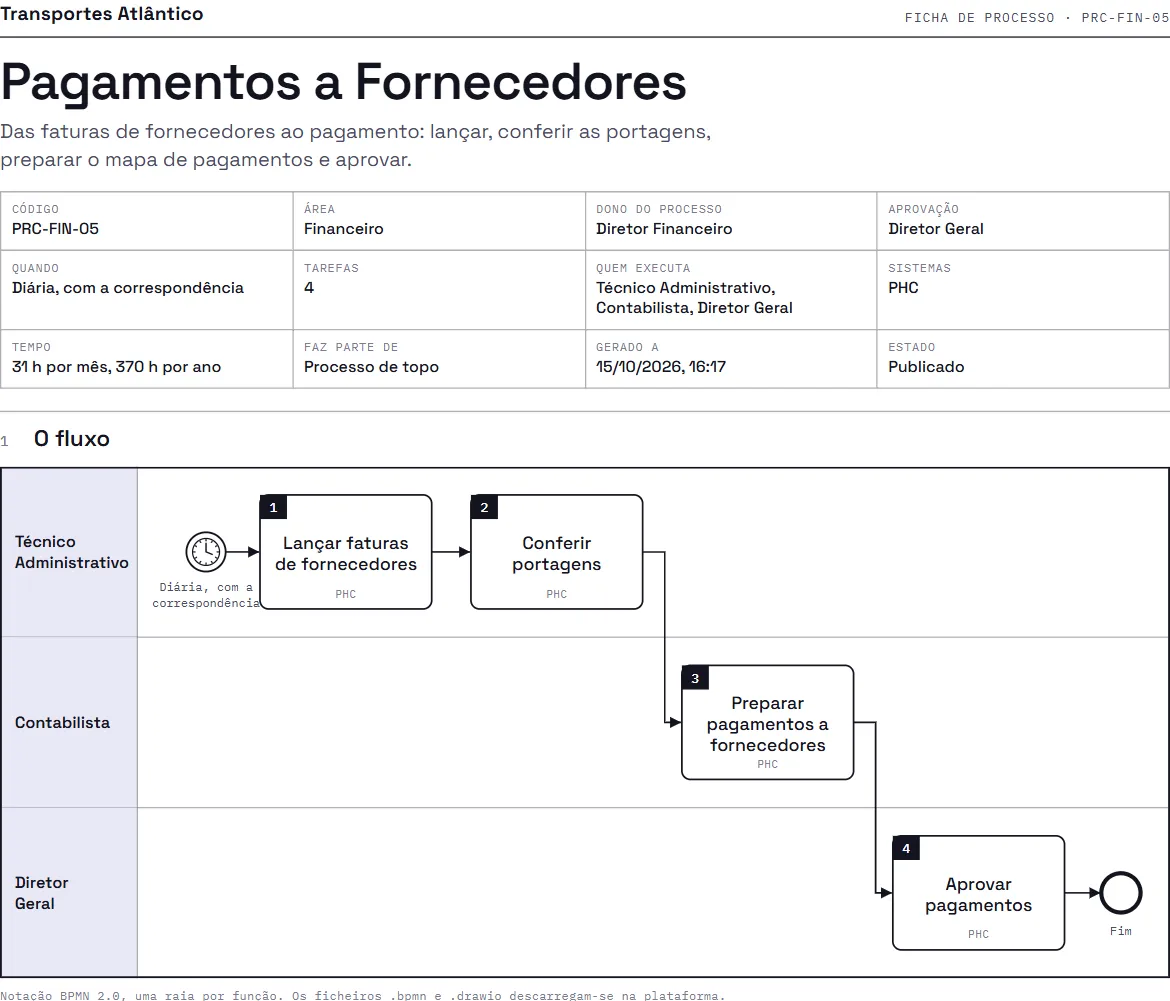
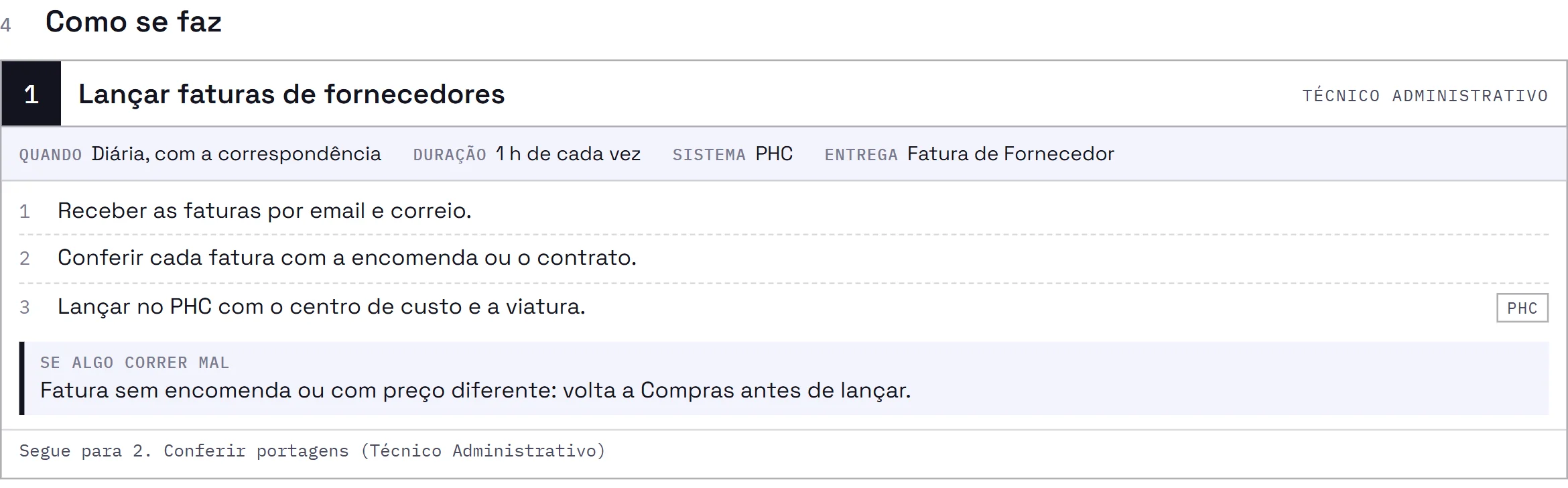
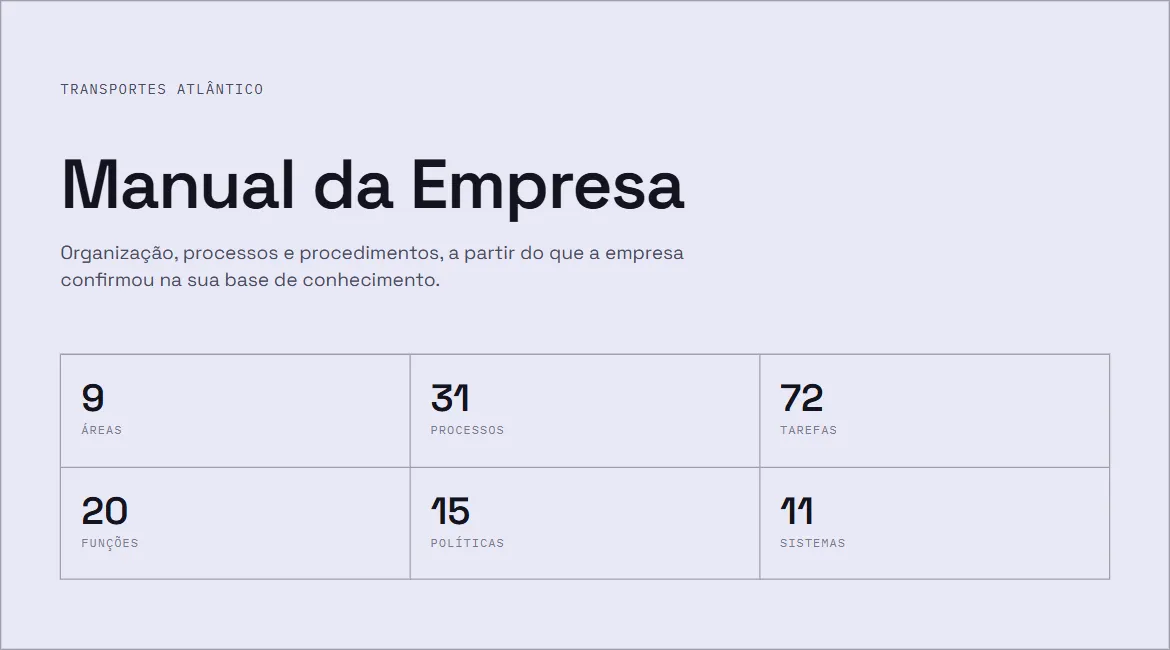
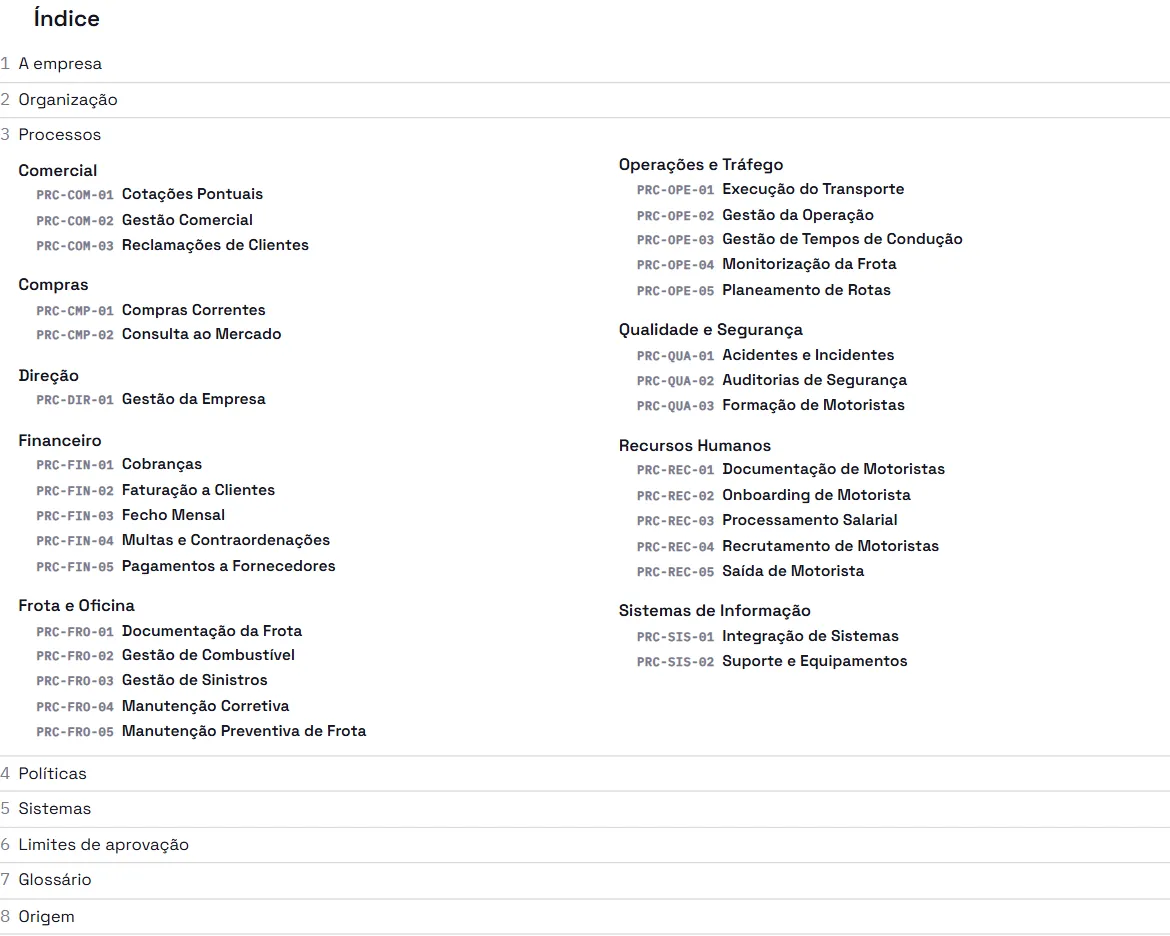
Company map
Areas, processes and tasks in a single view, with who does what.
Step-by-step procedures
Every task with its steps, the system used in each and the time it takes.
Who does what
Who is responsible, who carries it out and who approves, in every process.
Systems
Which system supports each step, and where work is still done by hand.
Automation assessment
The potential of each task and the hours at stake, to decide where to start.
Ready for AI
Your AI agents query the base with the source of every fact. And you can export everything: the data is yours.
Who's behind it, and where the data lives.
We do the gathering and structuring with you; the platform stores and maintains the base. aphexhouse.com
Your company's base is stored on servers in the EU.
Only the people your company authorises can get in.
Export everything whenever you like, in open formats.
Before we talk.
How long does it take?
2 weeks or less, covering the whole company, for companies of up to 100 people. Above that, scope and timing are agreed in the 30-minute call.
How much time does it ask of my team?
Not much: a short conversation with whoever does each task and a confirmation at the end, within the same 2 weeks. Nobody on your team has to write anything.
We already have an ERP and some manuals. Are they any use?
They're a starting point. The ERP records what happens, but it doesn't say how the work is done, who decides or what to do when something goes wrong. Existing manuals go in as sources.
Does it only work in transport?
No. The demo company is a haulier, but the method works for any company with processes: manufacturing, distribution, services.
And after the 2 weeks?
The base stays alive: when a process, a system or a person changes, it's updated and the team confirms it. Every fact has a date and a source, and you can export everything whenever you like, in PDF, BPMN and open formats.
Does it help with ISO 9001 certification?
It's a foundation: the standard requires the documented information needed for processes to work (clauses 4.4 and 7.5), and processes and procedures confirmed by the team are that foundation. Certification has other requirements, such as quality objectives and internal audits.
Where is the data stored?
In the European Union, with access only for the people your company authorises. It's used only for your company's work, and you can export everything at any time.
How much does it cost?
On request: it depends on the size of the company and the areas to cover. In the 30-minute call we give you an estimate for your case.
See the X-ray of a company like yours.
In 30 minutes: how your company is organised today, the X-ray of the demo company and the next step, if it makes sense.
or write to info@aphexhouse.com